
How many testers do you actually need?
Google asks for 12 testers opted in for 14 days in a row. Aim for 15. People forget, phones get wiped, someone opts out on day 9, and a replacement starts their own 14 days from scratch. Three spare seats mean one bad week does not send you back to the start.
Whichever route you take below, the job is the same: get 12 to 15 real people to open your Play Store testing link, tap accept, install the app and keep it for two weeks.
Which routes are there, and how do they compare?
Disclosure: TestPogo is our product and it is the paid service in the last row. The rest of this page tries to be fair to every route, including the free ones.
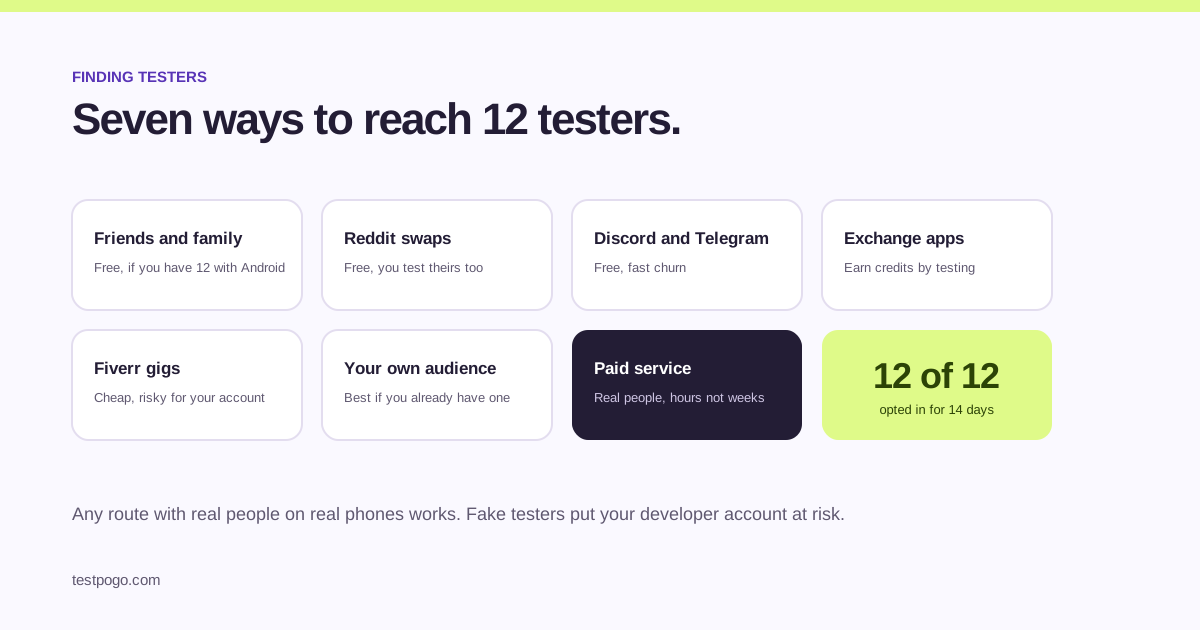
| Route | Cost | Time to 12 testers | Main risk | Good when |
|---|---|---|---|---|
| Friends and family | Free | Same day if you know 12 Android users | They forget to opt in or uninstall early | You have a real network and can chase them |
| Reddit swaps | Free, plus your time testing other apps | Days to weeks | Dropouts and low engagement | You have time and want honest feedback |
| Discord and Telegram groups | Free, plus your time | Days | Fast churn, people leave mid-test | You are already in developer communities |
| Tester exchange apps | Free, earn credits by testing others | Weeks of testing others first | Slow, and engagement varies | You have more time than money |
| Fiverr gigs | $5 to $30 | Hours to days | Emulators and fake accounts, account risk | Almost never |
| Your own audience | Free | Same day if the audience exists | Only works if you have one | You already have users or followers |
| Paid tester service | From $5 to $40 per app | Hours | Picking a provider with fake testers | You want it done this week |
Friends and family
The obvious first stop, and it works if you genuinely know 12 people with Android phones who will do what you ask for two weeks. Most developers find they know six.
Make it easy: one message with the opt-in link, what the app does, three things to try, and a reminder that they need to keep it installed for 14 days. Then check who actually opted in, because a yes in a group chat is not an opt-in.
Reddit swaps
Communities like r/AndroidClosedTesting exist for exactly this: you test someone’s app, they test yours. It is free, the feedback is often honest, and it is slow. Expect to test a dozen apps yourself and to lose a few of your own testers along the way.
It is also where developers compare notes on rejections and questionnaire answers, which makes it worth reading even if you recruit elsewhere.
Discord and Telegram groups
Faster than Reddit, with more churn. People join for a swap and leave when theirs is done, sometimes before your 14 days are up. If you go this way, over-recruit and check opt-ins every couple of days.
Tester exchange apps
Some services run a free exchange where you earn credits by testing other developers’ apps and spend them to have yours tested. If you have time and no budget it can work. Budget a few weeks, and remember that a tester earning credits is not always a tester using your app.
Fiverr gigs
Cheap and quick, and the reason this page has a risk column. Some gigs use real people. Many use emulators, recycled Google accounts or scripts that opt in and never open the app. Google looks for engagement, and fake testers are the kind of thing that can put a developer account at risk, not just a release.
If you use a gig anyway, ask exactly how the testers are sourced and what device they use, and check engagement yourself.
Your own audience
If you already have users, a newsletter or a following, this is the best route there is. Your testers care about the app, their feedback is worth having, and they are more likely to stay opted in. The catch is that most first-time developers do not have an audience yet, which is why the other six routes exist.
Paid tester services
A paid service supplies the testers and does the chasing for you. Prices in this market run from a few dollars to around $40 per app. The questions to ask any provider, including us: are the testers real people on real phones, how fast do they start, what happens when someone drops out, what do you get at the end, and what are the refund terms in writing.
TestPogo, for the record: 15 real testers on real Android phones for $12, or 5 for $5 if you only need a top-up. Standard testers start within 48 hours, we review initial-use evidence and request a final installation confirmation, replace anyone who drops out, and send a written feedback report you can quote in your application. Rejection-related refunds and retests are not included in Standard.
How do you keep testers engaged for 14 days?
Engagement matters because Google looks at it when you apply for production access, and it names too little engagement as a reason to ask for more testing.
- Give them a short task list on day one, three or four things to try.
- Send one update in the middle of the test, even if nothing changed.
- Make reporting a problem easy: a form, a group chat or an email address.
- Check who has opened the app and nudge the quiet ones by day 5.
- Never remove the track or the Google Group mid-test; testers who lose access have to opt in again.
What does Google think of each route?
Google asks how you recruited your testers and what they did. It does not ask you to find them alone. Any route with real people on real phones who actually use the app is fine, and you should describe it honestly in the application. The routes that cause trouble are the ones with emulators, fake accounts or people who never open the app.
Common questions
Can friends and family count as testers?
Yes. Friends and family count as testers if they opt in through your link and keep the app installed for the full 14 days. The risk is that they forget, so check opt-ins rather than trusting a yes.
Is it against Google’s rules to pay for testers?
No. Google asks how you recruited testers, not whether you paid. What breaks the rules is fake testers: emulators, recycled accounts, or people who never use the app.
How many testers should I recruit if I need 12?
Recruit 15. One or two people usually drop out over 14 days, and a replacement starts their own 14 days from scratch. Spare seats keep your clock intact.
Can I mix routes?
Yes. Many developers use friends and family for the first few testers and a paid service to reach 15. TestPogo’s 5-tester plan exists for exactly that.
Do testers need to be in my app’s countries?
Your closed test only reaches people in the countries you enabled for it, so testers need to live in one of them. Google itself does not name a country.
Does installing the app count as opting in?
No. A tester has to accept the invitation on your Play Store testing page, then install from there. Installs without the opt-in do not count towards the 12.
How fast can a paid service get me testers?
Hours, not days. TestPogo assigns Standard testers within 48 hours of payment as long as your links work; other providers quote a few hours to two days.
15 real testers, ready within 48 hours.
From $5 per app. Pick a plan and share two links.